
Uysal Ünalan, İlke
Loading...

Profile URL
Name Variants
Uysal Unalan, Ilke
Ünalan, Ilke Uysal
Unalan, Ilke Uysal
Ünalan, Ilke Uysal
Unalan, Ilke Uysal
Job Title
Email Address
iuysalunalan@gmail.com
Main Affiliation
05.07. Food Engineering
Status
Former Staff
Website
ORCID ID
Scopus Author ID
Turkish CoHE Profile ID
Google Scholar ID
WoS Researcher ID
Sustainable Development Goals
 1
1NO POVERTY
0
Research Products
 2
2ZERO HUNGER
0
Research Products
 3
3GOOD HEALTH AND WELL-BEING
0
Research Products
 4
4QUALITY EDUCATION
0
Research Products
 5
5GENDER EQUALITY
0
Research Products
 6
6CLEAN WATER AND SANITATION
0
Research Products
 7
7AFFORDABLE AND CLEAN ENERGY
1
Research Products
 8
8DECENT WORK AND ECONOMIC GROWTH
0
Research Products
 9
9INDUSTRY, INNOVATION AND INFRASTRUCTURE
3
Research Products
 10
10REDUCED INEQUALITIES
0
Research Products
 11
11SUSTAINABLE CITIES AND COMMUNITIES
0
Research Products
 12
12RESPONSIBLE CONSUMPTION AND PRODUCTION
0
Research Products
 13
13CLIMATE ACTION
0
Research Products
 14
14LIFE BELOW WATER
0
Research Products
 15
15LIFE ON LAND
0
Research Products
 16
16PEACE, JUSTICE AND STRONG INSTITUTIONS
0
Research Products
 17
17PARTNERSHIPS FOR THE GOALS
0
Research Products

Documents
32
Citations
1368
h-index
20

Documents
4
Citations
99

Scholarly Output
4
Articles
4
Views / Downloads
29/49
Supervised MSc Theses
0
Supervised PhD Theses
0
WoS Citation Count
90
Scopus Citation Count
108
Patents
0
Projects
0
WoS Citations per Publication
22.50
Scopus Citations per Publication
27.00
Open Access Source
3
Supervised Theses
0
| Journal | Count |
|---|---|
| Nanomaterıals | 2 |
| Envıronmental Pollutıon | 1 |
| Polymers | 1 |
Current Page: 1 / 1
Scopus Quartile Distribution
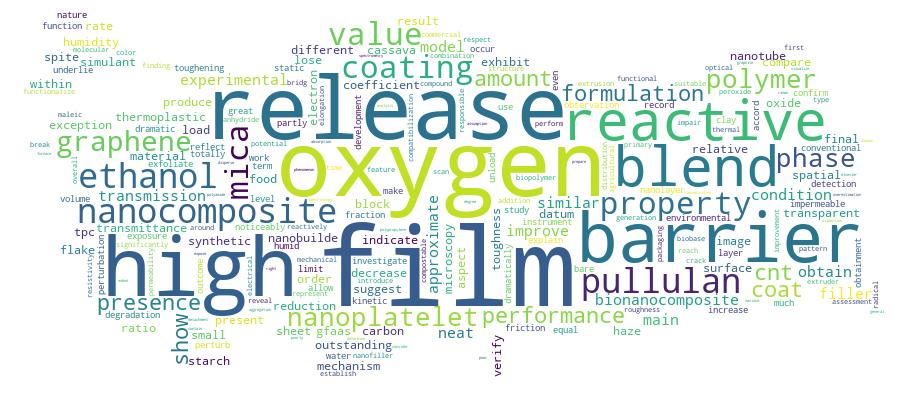
Competency Cloud
4 results
Scholarly Output Search Results
Now showing 1 - 4 of 4
Article Citation - WoS: 24Citation - Scopus: 23Graphene Oxide Bionanocomposite Coatings With High Oxygen Barrier Properties(Mdpi, 2016-12-21) Unalan, Ilke Uysal; Boyaci, Derya; Ghaani, Masoud; Trabattoni, Silvia; Farris, StefanoIn this work, we present the development of bionanocomposite coatings on poly(ethylene terephthalate) (PET) with outstanding oxygen barrier properties. Pullulan and graphene oxide (GO) were used as main polymer phase and nanobuilding block (NBB), respectively. The oxygen barrier performance was investigated at different filler volume fractions (phi) and as a function of different relative humidity (RH) values. Noticeably, the impermeable nature of GO was reflected under dry conditions, in which an oxygen transmission rate (OTR, mLm(-2)24 h(-1)) value below the detection limit of the instrument (0.01 mLm(-2)24 h(-1)) was recorded, even for phi as low as 0.0004. A dramatic increase of the OTR values occurred in humid conditions, such that the barrier performance was totally lost at 90% RH (the OTR of coated PET films was equal to the OTR of bare PET films). Modelling of the experimental OTR data by Cussler's model suggested that the spatial ordering of GO sheets within the main pullulan phase was perturbed because of RH fluctuations. In spite of the presence of the filler, all the formulations allowed the obtainment of final materials with haze values below 3%, the only exception being the formulation with the highest loading of GO (phi approximate to 0.03). The mechanisms underlying the experimental observations are discussed.Article Citation - WoS: 38Citation - Scopus: 52Toughening of Poly(lactic Acid) and Thermoplastic Cassava Starch Reactive Blends Using Graphene Nanoplatelets(Mdpi, 2018-01-19) Bher, Anibal; Unalan, Ilke Uysal; Auras, Rafael; Rubino, Maria; Schvezov, Carlos E.Poly(lactic acid) (PLA) was reactively blended with thermoplastic cassava starch (TPCS) and functionalized with commercial graphene (GRH) nanoplatelets in a twin-screw extruder, and films were produced by cast-film extrusion. Reactive compatibilization between PLA and TPCS phases was reached by introducing maleic anhydride and a peroxide radical during the reactive blending extrusion process. Films with improved elongation at break and toughness for neat PLA and PLA-g-TPCS reactive blends were obtained by an addition of GRH nanoplatelets. Toughness of the PLA-g-TPCS-GRH was improved by similar to 900% and similar to 500% when compared to neat PLA and PLA-g-TPCS, respectively. Crack bridging was established as the primary mechanism responsible for the improvement in the mechanical properties of PLA and PLA-g-TPCS in the presence of the nanofiller due to the high aspect ratio of GRH. Scanning electron microscopy images showed a non-uniform distribution of GRH nanoplatelets in the matrix. Transmittance of the reactive blend films decreased due to the TPCS phase. Values obtained for the reactive blends showed similar to 20% transmittance. PLA-GRH and PLA-g-TPCS-GRH showed a reduction of the oxygen permeability coefficient with respect to PLA of around 35% and 50%, respectively. Thermal properties, molecular structure, surface roughness, XRD pattern, electrical resistivity, and color of the films were also evaluated. Biobased and compostable reactive blend films of PLA-g-TPCS compounded with GRH nanoplatelets could be suitable for food packaging and agricultural applications.Article Citation - WoS: 9Citation - Scopus: 13Carbon Nanotube Release From Polymers Into a Food Simulant(Elsevier Sci Ltd, 2017-10) Xia, Yining; Unalan, Ilke Uysal; Rubino, Maria; Auras, RafaelThe release assessment of multi-walled carbon nanotubes (CNTs) was performed on two types of polymer-CNT nanocomposites: polypropylene (PP) and polyamide 6 (PA6) containing 3 wt% CNT. Nanocomposite films were prepared and then exposed to ethanol as a fatty-food simulant at 40 degrees C, and the amount of CNT release into ethanol was determined by ultraviolet-visible spectroscopy (UV-Vis) and graphite furnace atomic absorption spectrometry (GFAAS). The CNTs released into ethanol were visualized by transmission electron microscopy (TEM) and verified by Raman spectroscopy. UV-Vis analysis showed a very small amount of CNT release from the nanocomposite films into ethanol over 60 d: maximum CNT concentrations in ethanol were 1.3 mg/L for the PP-CNT film and 1.2 mg/L for the PA6-CNT film. GFAAS results indicated that the amount of CNTs released into ethanol after 12 d was over 20-fold higher than the results obtained by UV-Vis. Overestimation of CNT release by GFAAS suggested aggregation and poor dispersion of CNTs in the solvent. This assumption was verified by TEM images exhibiting the embedded CNTs in the polymer flakes, which could be poorly dispersed in the solvent. In general, CNT release from the nanocomposite films was considered a surface phenomenon, as indicated by detachment of CNT-containing polymer flakes from the film surface. (C) 2017 Elsevier Ltd. All rights reserved.Article Citation - WoS: 19Citation - Scopus: 20Transparent Pullulan/Mica Nanocomposite Coatings With Outstanding Oxygen Barrier Properties(Mdpi, 2017-09-19) Unalan, Ilke Uysal; Boyaci, Derya; Trabattoni, Silvia; Tavazzi, Silvia; Farris, StefanoThis study presents a new bionanocomposite coating on poly(ethylene terephthalate) (PET) made of pullulan and synthetic mica. Mica nanolayers have a very high aspect ratio (alpha), at levels much greater than that of conventional exfoliated clay layers (e.g., montmorillonite). A very small amount of mica (0.02 wt %, which is phi approximate to 0.00008) in pullulan coatings dramatically improved the oxygen barrier performance of the nanocomposite films under dry conditions, however, this performance was partly lost as the environmental relative humidity (RH) increased. This outcome was explained in terms of the perturbation of the spatial ordering of mica sheets within the main pullulan phase, because of RH fluctuations. This was confirmed by modelling of the experimental oxygen transmission rate (OTR) data according to Cussler's model. The presence of the synthetic nanobuilding block (NBB) led to a decrease in both static and kinetic coefficients of friction, compared with neat PET (approximate to 12% and 23%, respectively) and PET coated with unloaded pullulan (approximate to 26% reduction in both coefficients). In spite of the presence of the filler, all of the coating formulations did not significantly impair the overall optical properties of the final material, which exhibited haze values below 3% and transmittance above 85%. The only exception to this was represented by the formulation with the highest loading of mica (1.5 wt %, which is phi approximate to 0.01). These findings revealed, for the first time, the potential of the NBB mica to produce nanocomposite coatings in combination with biopolymers for the generation of new functional features, such as transparent high oxygen barrier materials.