
Bulak Uygun, Begüm
Loading...

Profile URL
Name Variants
Bulak Uygun, Begum
Job Title
Email Address
begum.bulak@ieu.edu.tr
Main Affiliation
08.01. Law
Status
Former Staff
Website
ORCID ID
Scopus Author ID
Turkish CoHE Profile ID
Google Scholar ID
WoS Researcher ID
Sustainable Development Goals
 1
1NO POVERTY
0
Research Products
 2
2ZERO HUNGER
0
Research Products
 3
3GOOD HEALTH AND WELL-BEING
0
Research Products
 4
4QUALITY EDUCATION
0
Research Products
 5
5GENDER EQUALITY
0
Research Products
 6
6CLEAN WATER AND SANITATION
0
Research Products
 7
7AFFORDABLE AND CLEAN ENERGY
0
Research Products
 8
8DECENT WORK AND ECONOMIC GROWTH
0
Research Products
 9
9INDUSTRY, INNOVATION AND INFRASTRUCTURE
0
Research Products
 10
10REDUCED INEQUALITIES
0
Research Products
 11
11SUSTAINABLE CITIES AND COMMUNITIES
0
Research Products
 12
12RESPONSIBLE CONSUMPTION AND PRODUCTION
0
Research Products
 13
13CLIMATE ACTION
0
Research Products
 14
14LIFE BELOW WATER
0
Research Products
 15
15LIFE ON LAND
0
Research Products
 16
16PEACE, JUSTICE AND STRONG INSTITUTIONS
2
Research Products
 17
17PARTNERSHIPS FOR THE GOALS
0
Research Products

This researcher does not have a Scopus ID.

Documents
1
Citations
0

Scholarly Output
3
Articles
3
Views / Downloads
8/16
Supervised MSc Theses
0
Supervised PhD Theses
0
WoS Citation Count
0
Scopus Citation Count
0
Patents
0
Projects
0
WoS Citations per Publication
0.00
Scopus Citations per Publication
0.00
Open Access Source
3
Supervised Theses
0
| Journal | Count |
|---|---|
| Ceza Hukuku ve Kriminoloji Dergisi | 1 |
| Human Rights Review | 1 |
| Law and Justice Review | 1 |
Current Page: 1 / 1
Scopus Quartile Distribution
Quartile distribution chart data is not available
Competency Cloud
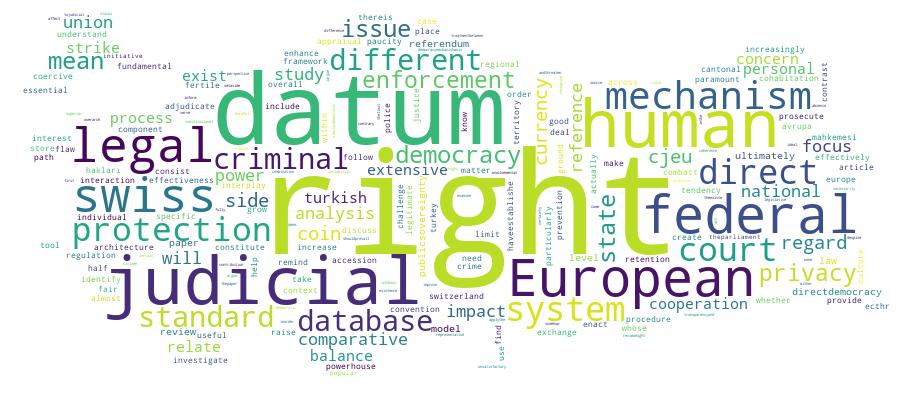
3 results
Scholarly Output Search Results
Now showing 1 - 3 of 3
Article Direct Democracy and Judicial Review: a Comparative Study of Us and Swiss Legal Systems(2018) Bulak Uygun, Begüm; Uygun, Begüm BulakIn the US, almost half of the states haveestablished direct democracy mechanisms, but thereis a paucity of such mechanisms at the federal level.By contrast, the Swiss system knows extensive directdemocracy at both the cantonal and the federal level,including rights of referendum on laws enacted by theparliament and popular initiatives for constitutionalrevision.This paper focuses on how direct democracymechanisms, such as referendums and citizens’initiatives serving an overarching ideal of publicsovereignty, may inform and affect judicial review. Thepaper also examines certain differences in treatmentbetween federal and state laws when it comes tojudicial review, as the courts will not necessarily applythe same standards despite the existence of similardemocratic mechanisms at both levels.In this contribution, I first argue that none of theexisting systems is fully satisfactory. The status quo inthe Swiss model might be a source of instability andthreaten legal certainty, coherence and transparencyand could ultimately be more harmful to publicsovereignty in that federal acts may in practice be setaside without constitutional basis. As to the US model,the combination of an absence of citizen involvementat the federal level with extensive judicial reviewmight ultimately be deemed as unsatisfactory fromthe perspective of democratic rights.This does not mean however that directdemocracy is somehow superior to representative,or that either of judicial or legislative power shouldprevail over the other. To the contrary, in this paper Iargue that in a federal system all are complementary.Furthermore, I claim that one should recognise thelimits of direct democracy and of judicial review inorder to improve both by striking a balance betweenthem.Article Cjeu and Ecthr: Two Sides of the Same Coin or Different Currencies ?(2017) Bulak Uygun, Begüm; Uygun, Begüm BulakThe protection of fundamental human rights across Europe reminds the issue of the European Union (EU) accession to the European Convention on Human Rights (ECHR). The analysis of the interaction between the Court of Justice of the European Union (CJEU) and the European Court of Human Rights (ECtHR) is essential for a better understanding of the multi-layered human rights architecture in Europe.With reference to multi-level components, this study focus on the following issues in order to find out whether the CJEU and ECtHR consist two sides of the same coin - meaning that they adjudicate human rights in the same way - or if they constitute different currencies – meaning that they have different impacts in human rights protection. An overall appraisal of the cohabitation of these two judicial powerhouses will be made by reference to the state of human rights protection within the regional mechanisms and their impact at national level.Article Databases and Criminal Procedures in Switzerland and Turkey With Regard To European Council’s Standards(2017) Bulak Uygun, Begüm; Uygun, Begüm BulakDatabases are increasingly used by law enforcement to effectively investigate and prosecute criminal offences. The growing tendency and need for law enforcement to use big data is particularly challenging when the data is stored abroad. As law enforcement authorities’ coercive powers are limited to their national territories, the path to enhanced judicial cooperation in criminal matters and police cooperation is of paramount importance. With the increasing use of big data, personal data processing takes place when the concerned individuals whose data is actually being processed are absent. This raises issues related to data regulations and to the effectiveness of existing mechanisms of legal protection for data subjects. This article deals with concerns relating to privacy protection in the context of data retention and judicial data exchange in Europe. To this end, a comparative analysis of Swiss and Turkish legal frameworks with regard to the European Court of Human Right’s case law provides a useful tool in identifying the legal standards that can help strike a fair balance between legitimate interests in database use and personal privacy protection. The specifics of the interplay between the right to privacy and the prevention and combatting of crime in Swiss and Turkish cultures also creates a fertile ground to discuss the flaws in existing regulations.