
Aşkar, Petek
Loading...

Profile URL
Name Variants
Job Title
Email Address
petek.askar@ieu.edu.tr
Main Affiliation
02.05. Sociology
Status
Former Staff
Website
ORCID ID
Scopus Author ID
Turkish CoHE Profile ID
Google Scholar ID
WoS Researcher ID
Sustainable Development Goals
 1
1NO POVERTY
0
Research Products
 2
2ZERO HUNGER
0
Research Products
 3
3GOOD HEALTH AND WELL-BEING
0
Research Products
 4
4QUALITY EDUCATION
2
Research Products
 5
5GENDER EQUALITY
0
Research Products
 6
6CLEAN WATER AND SANITATION
0
Research Products
 7
7AFFORDABLE AND CLEAN ENERGY
0
Research Products
 8
8DECENT WORK AND ECONOMIC GROWTH
0
Research Products
 9
9INDUSTRY, INNOVATION AND INFRASTRUCTURE
0
Research Products
 10
10REDUCED INEQUALITIES
0
Research Products
 11
11SUSTAINABLE CITIES AND COMMUNITIES
0
Research Products
 12
12RESPONSIBLE CONSUMPTION AND PRODUCTION
0
Research Products
 13
13CLIMATE ACTION
0
Research Products
 14
14LIFE BELOW WATER
0
Research Products
 15
15LIFE ON LAND
0
Research Products
 16
16PEACE, JUSTICE AND STRONG INSTITUTIONS
0
Research Products
 17
17PARTNERSHIPS FOR THE GOALS
1
Research Products

Documents
47
Citations
1053
h-index
14

Documents
39
Citations
780

Scholarly Output
6
Articles
5
Views / Downloads
20/6
Supervised MSc Theses
0
Supervised PhD Theses
0
WoS Citation Count
44
Scopus Citation Count
41
Patents
0
Projects
0
WoS Citations per Publication
7.33
Scopus Citations per Publication
6.83
Open Access Source
2
Supervised Theses
0
| Journal | Count |
|---|---|
| Educatıonal Technology & Socıety | 1 |
| Egıtım Ve Bılım-Educatıon And Scıence | 1 |
| Hacettepe Üniversitesi Eğitim Fakültesi Dergisi | 1 |
| Hacettepe Unıversıtesı Egıtım Fakultesı Dergısı-Hacettepe Unıversıty Journal of Educatıon | 1 |
| Journal of Computıng in Hıgher Educatıon | 1 |
Current Page: 1 / 2
Scopus Quartile Distribution
Competency Cloud
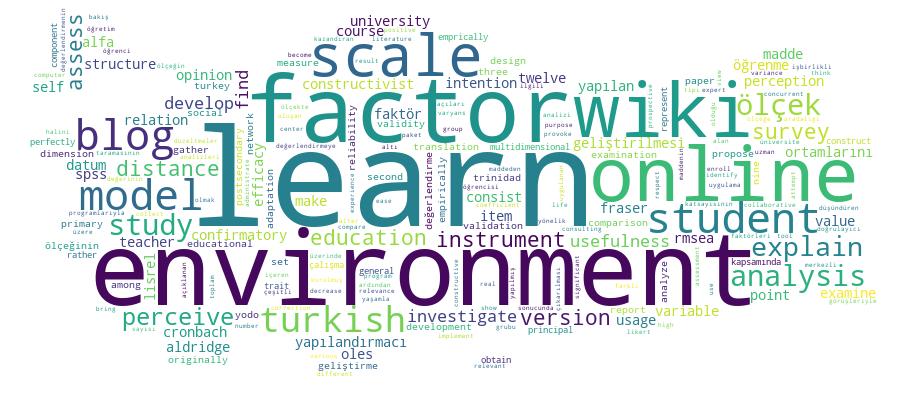
6 results
Scholarly Output Search Results
Now showing 1 - 6 of 6
Article Yapılandırmacı Öğrenme Ortamlarını Değerlendirme Ölçeğinin Geliştirilmesi(2010) Aşkar, Petek; Argün, SelayBu çalışma kapsamında yapılandırmacı öğrenme ortamlarını değerlendirmeye yönelik, 7’li Likert tipi bir ölçek geliştirilmesi amaçlanmıştır. Yapılan alan taramasının ardından, ölçek; öğrenci merkezli, düşündüren, işbirlikli, yaşamla ilgili, öğretim ve değerlendirmenin bir aradalığı ile farklı bakış açıları kazandıran olmak üzere altı faktör üzerine kurulmuş, bu faktörleri içeren 30 madde yazılmıştır. Uygulama grubu ve uzman görüşleriyle, ölçekte çeşitli düzeltmeler yapılmış ve madde sayısı 29’a düşürülmüştür. 247 üniversite öğrencisi üzerinde uygulanan ölçeğin analizleri SPSS 13 ve LISREL 8.8 paket programlarıyla yapılmıştır. Yapılan doğrulayıcı faktör analizi sonucunda, bir maddenin çıkarılması ile ölçek 28 maddeden oluşan son halini almıştır. Açıklanan toplam varyans %66,65 olarak bulunmuştur. Ölçeğe ait, Cronbach Alfa katsayısının .96, RMSEA değerinin ise 0,076 olduğu belirlenmiştir.Article Citation - WoS: 2Citation - Scopus: 1An Examination of the Factor Structure of the Turkish Version of the Online Learning Environment Survey(Turkish Education Assoc, 2011) Ozkok, Alev; Yurdugul, Halil; Aşkar, Petek; Özkök, Güldem AlevThe primary aim of this study was to examine the reliability and validity of the Turkish version of the Online Learning Environment Survey (OLES) in postsecondary distance education. The OLES is a 54 item instrument for assessing social-psychological perceptions among distance education students. The second aim was to investigate empirically perception of the online learning environment in Turkish context. This paper consisted of three models explaining online learning environments in the Turkish context. Model I, based on relations of originally item-construct reported by Trinidad, Aldridge & Fraser, (2004), was analyzed with gathered data from Turkey setting by the translation, adaptation, and validation of the Online Learning Environment Survey (OLES) (Trinidad, Aldridge & Fraser, 2004) in a new Turkish-language form. In Model I, the OLES was designed to measure nine dimensions of online educational environment. The fit of the proposed multidimensional factor structure was examined with 902 post-secondary distance education students in two institutions. Model II, based on relations of emprically item-construct which were obtained with principal component analysis, was investigated with first-order confirmatory factor analysis. Model II consist of twelve subconstructs. Model III, with a higher-order construct with twelve first-order factors of OLES-TR, was perfectly represented as a general online learning environments trait rather than the OLES.Conference Object Citation - WoS: 1Social Network Analysis for E-Learning Environments(Elsevier Science Bv, 2011) Aşkar, Petek[Abstract Not Available]Article Citation - WoS: 7The Development of a Scale on Assessing Constructivist Learning Environments(Hacettepe Univ, 2010) Arkun, Selay; Aşkar, PetekThis study attempts to develop a 7-point Liken-type scale for assessing the constructivist learning environments The scale is based on 6 factors which were developed by consulting the relevant literature These factors are student centered thought provoking collaborative life relevance concurrent learning and assessment bringing different view points With the opinions of study group and the expert some corrections were made on scale and item number decreased to 29 The scale implemented on 247 university students and analysis was made with SPSS and LISREL Alter the confirmatory factor analysis the scale became to its real version Explained variance is found to be %66 65 The cronbach alfa coefficient was found as 96 and the RMSEA value as 0 076Article Citation - WoS: 33Citation - Scopus: 38The Comparison of the Opinions of the University Students on the Usage of Blog and Wiki for Their Courses(IEEE Computer Soc, Learning Technology Task Force, 2012) Avci, Ummuhan; Aşkar, PetekThe purpose of this study was to investigate the use of blogs and wikis as constructive tools in the computer courses of prospective teachers and compare them with respect to perceived usefulness, perceived ease of use, intention, self efficacy, and anxiety. Ninty-two students who were enrolled in various teacher education programs used blog and wiki for their courses. After their experiences with blog and wiki, the data were collected by administrating the instrument developed by the researchers. The results showed that students were positive to blog and wiki usage in the teaching-learning process. However they found wiki more useful. Both perceived usefulness and self efficacy variables explain 71% of blog and wiki usage. This value points to a very high and significant correlation. Perceived usefulness has been identified as the variable that could explain intention by itself at the most.Article Citation - WoS: 1Citation - Scopus: 2A Case Study on the Usage of Lecture Capture: Perceptions of Students, Faculty Members and Administrators(Springer, 2021-11-13) Ustunluoglu, Evrim; Mumcu, Filiz; Uslu, Nilufer Atman; Askar, PetekApproaches and methodologies based on technology are becoming more widespread in education. One of these technologies, Lecture Capture (LC), is particularly beneficial in higher education, since it allows students to improve learning via flexible access to video-recorded lectures. However, while LC is becoming more widespread in higher education, research on its impact on learning and teaching have prompted further discussion regarding its usage. The purpose of this study is to explore in depth the perceptions of students, faculty members, and administrators on the usage of LC in higher education, and to improve the system by identifying its key benefits and drawbacks. In the study, an embedded single-case study methodology was employed, focusing on a university's use of LC. Analysis of the findings identified three main themes: purposes for which the system was used; changes occurred through usage of the system; plus, concerns and issues. The study highlights the importance of the pedagogical, methodological, and technical aspects of the LC system.