Kahveci̇, Erol

Loading...
Profile Picture
Name Variants
Job Title
Email Address
erol.kahveci@ieu.edu.tr
Main Affiliation
02.05. Sociology
Status
Former Staff
Website
Scopus Author ID
Turkish CoHE Profile ID
Google Scholar ID
WoS Researcher ID

Sustainable Development Goals

5

GENDER EQUALITY
GENDER EQUALITY Logo

0

Research Products

9

INDUSTRY, INNOVATION AND INFRASTRUCTURE
INDUSTRY, INNOVATION AND INFRASTRUCTURE Logo

1

Research Products

13

CLIMATE ACTION
CLIMATE ACTION Logo

0

Research Products

8

DECENT WORK AND ECONOMIC GROWTH
DECENT WORK AND ECONOMIC GROWTH Logo

2

Research Products

14

LIFE BELOW WATER
LIFE BELOW WATER Logo

0

Research Products

17

PARTNERSHIPS FOR THE GOALS
PARTNERSHIPS FOR THE GOALS Logo

0

Research Products

1

NO POVERTY
NO POVERTY Logo

1

Research Products

2

ZERO HUNGER
ZERO HUNGER Logo

0

Research Products

4

QUALITY EDUCATION
QUALITY EDUCATION Logo

1

Research Products

11

SUSTAINABLE CITIES AND COMMUNITIES
SUSTAINABLE CITIES AND COMMUNITIES Logo

0

Research Products

16

PEACE, JUSTICE AND STRONG INSTITUTIONS
PEACE, JUSTICE AND STRONG INSTITUTIONS Logo

0

Research Products

3

GOOD HEALTH AND WELL-BEING
GOOD HEALTH AND WELL-BEING Logo

0

Research Products

6

CLEAN WATER AND SANITATION
CLEAN WATER AND SANITATION Logo

0

Research Products

12

RESPONSIBLE CONSUMPTION AND PRODUCTION
RESPONSIBLE CONSUMPTION AND PRODUCTION Logo

0

Research Products

10

REDUCED INEQUALITIES
REDUCED INEQUALITIES Logo

0

Research Products

15

LIFE ON LAND
LIFE ON LAND Logo

0

Research Products

7

AFFORDABLE AND CLEAN ENERGY
AFFORDABLE AND CLEAN ENERGY Logo

0

Research Products
Documents

3

Citations

13

h-index

2

Documents

5

Citations

9

Scholarly Output

2

Articles

2

Views / Downloads

0/0

Supervised MSc Theses

0

Supervised PhD Theses

0

WoS Citation Count

3

Scopus Citation Count

4

WoS h-index

1

Scopus h-index

1

Patents

0

Projects

0

WoS Citations per Publication

1.50

Scopus Citations per Publication

2.00

Open Access Source

1

Supervised Theses

0

JournalCount
Internatıonal Revıew of Socıal Hıstory1
Mıddle Eastern Studıes1
Current Page: 1 / 1

Scopus Quartile Distribution

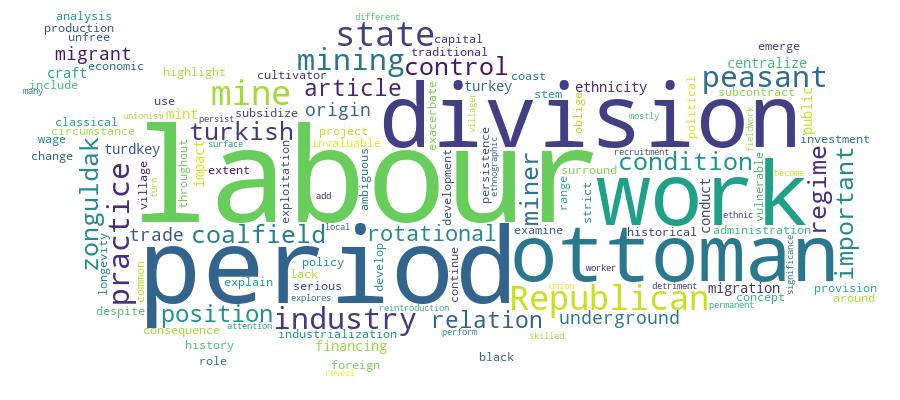
Competency Cloud

GCRIS Competency Cloud

Scholarly Output Search Results

Now showing 1 - 2 of 2
  • Article
    Citation - WoS: 2
    Citation - Scopus: 4
    Migration, Ethnicity, and Divisions of Labour in the Zonguldak Coalfield, Turdkey
    (Cambridge Univ Press, 2015) Kahveci̇, Erol
    This article examines labour relations and labour conditions in the Zonguldak coalfield on the Black Sea coast in Turkey. From 1867, peasants from surrounding villages were obliged to work in the mines on a rotational basis. Peasants continued to work part-time in the mines after the end of this forced-labour regime in 1921, and after its reintroduction between 1940 and 1947. The article explores the significance of the recruitment of local villagers for the division of labour in the mines. Underground work was performed by low-skilled rotational peasant-miners, while migrants became skilled, full-time surface workers. Different ethnic origins added to the division of labour between these two groups. Attention is then turned to trade unionism in Zonguldak. The miners' trade union was controlled by permanent workers, mostly migrants of Laz origin, to the detriment of underground peasant-workers. Ethnographic fieldwork reveals that these divisions have persisted over many years.
  • Article
    Citation - WoS: 1
    The Condition of the Ottoman Mine Labour and Its Impact on the Republican Period
    (Routledge Journals, Taylor & Francis Ltd, 2015) Kahveci̇, Erol
    In the Ottoman state, mining was important for the conduct of war, mints, public works, crafts industry, and financing the centralized administration system. In the republican period, mines were also important in the state's industrialization project, and they were used to subsidize the developing industries through provision of low-cost raw materials. These policies of the Ottoman and Turkish states had serious consequences for mine labour. Analysis of the Ottoman mining industry in the classical and post-classical periods, and also during the Turkish Republican period, highlights a range of emerging patterns. These include the strict control of the production by the state, the common practice of subcontracting, the role of foreign capital in the history of mining, the village-based division of labour around the mines, the use of peasant cultivator miners, the exploitation of unfree labour, the lack of investment, and traditional labour-intensive working conditions. The concept of development and persistence' is invaluable in explaining the longevity and extent of these practices stemming from historical circumstances, and we can see the persistence of some of these practices during the Republican period, despite the changes in the political regime and economic development. Throughout, the miners have been in a vulnerable position in relation to the state, exacerbated by their ambiguous peasant-miner position as wage labourers.