
Aydemir Çaylı, Nuran
Loading...

Profile URL
Name Variants
Aydemir, Nuran
Aydemir, N
Aydemir, N.
Aydemir, N
Aydemir, N.
Job Title
Email Address
nuran.aydemir@ieu.edu.tr
Main Affiliation
02.04. Psychology
Status
Former Staff
Website
ORCID ID
Scopus Author ID
Turkish CoHE Profile ID
Google Scholar ID
WoS Researcher ID
Sustainable Development Goals
 1
1NO POVERTY
0
Research Products
 2
2ZERO HUNGER
0
Research Products
 3
3GOOD HEALTH AND WELL-BEING
2
Research Products
 4
4QUALITY EDUCATION
0
Research Products
 5
5GENDER EQUALITY
0
Research Products
 6
6CLEAN WATER AND SANITATION
0
Research Products
 7
7AFFORDABLE AND CLEAN ENERGY
0
Research Products
 8
8DECENT WORK AND ECONOMIC GROWTH
0
Research Products
 9
9INDUSTRY, INNOVATION AND INFRASTRUCTURE
0
Research Products
 10
10REDUCED INEQUALITIES
0
Research Products
 11
11SUSTAINABLE CITIES AND COMMUNITIES
0
Research Products
 12
12RESPONSIBLE CONSUMPTION AND PRODUCTION
0
Research Products
 13
13CLIMATE ACTION
0
Research Products
 14
14LIFE BELOW WATER
0
Research Products
 15
15LIFE ON LAND
0
Research Products
 16
16PEACE, JUSTICE AND STRONG INSTITUTIONS
0
Research Products
 17
17PARTNERSHIPS FOR THE GOALS
0
Research Products

Documents
16
Citations
530
h-index
10

Documents
21
Citations
543

Scholarly Output
10
Articles
9
Views / Downloads
20/41
Supervised MSc Theses
0
Supervised PhD Theses
0
WoS Citation Count
303
Scopus Citation Count
286
Patents
0
Projects
0
WoS Citations per Publication
30.30
Scopus Citations per Publication
28.60
Open Access Source
6
Supervised Theses
0
| Journal | Count |
|---|---|
| Epılepsy & Behavıor | 3 |
| Seızure-European Journal of Epılepsy | 2 |
| Epılepsı | 1 |
| Epılepsıa | 1 |
| Developmental Psychology | 1 |
Current Page: 1 / 2
Scopus Quartile Distribution
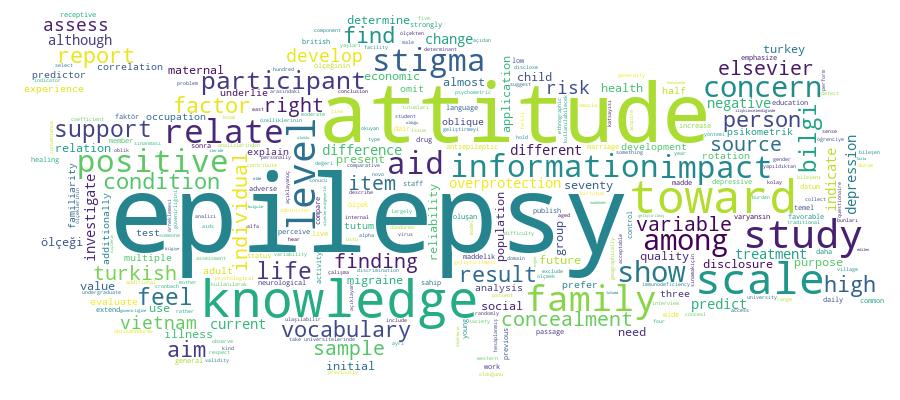
Competency Cloud
10 results
Scholarly Output Search Results
Now showing 1 - 10 of 10
Article Citation - WoS: 49Citation - Scopus: 44Familiarity With, Knowledge Of, and Attitudes Toward Epilepsy in Turkey(Academic Press Inc Elsevier Science, 2011-02) Aydemir, NuranThe aims of the study described here were to investigate familiarity with, knowledge of, and attitudes toward epilepsy and to assess indicators of positive attitudes toward epilepsy. Questionnaires previously developed for the Turkish population were used to assess knowledge and attitudes. Data were collected from 1354 randomly selected adults. Three-quarters of the sample had heard something about epilepsy, and almost half of the sample personally knew someone with epilepsy. The sample had a moderate level of knowledge of and favorable attitudes toward epilepsy in general. Variables that predicted positive attitudes were young age, male gender, and high level of knowledge of epilepsy. The results for both knowledge and attitudes indicate that the findings of the study are largely in line with previous studies, but where there is wide variability among previous findings, the findings for the Turkish population lie, just as Turkey does geographically, between those of the East and West. (C) 2010 Elsevier Inc. All rights reserved.Article Citation - WoS: 47Citation - Scopus: 48Multiple Impacts of Epilepsy and Contributing Factors: Findings From an Ethnographic Study in Vietnam(Academic Press Inc Elsevier Science, 2009-11) Aydemir, Nuran; Dang Vu Trung; Snape, Dee; Baker, Gus A.; Jacoby, AnnWe investigated issues related to treatment, impact of epilepsy, attitudes toward epilepsy, and disclosure in Vietnam through in-depth interviews with people with epilepsy (PWE) and their family members. We found that although participants prefer Western to traditional treatment, they experience problems in accessing different kinds of antiepileptic drugs and higher-level treatment facilities and with respect to treatment expenses. The impact of epilepsy can be observed in a wide range of daily living activities which include working, education, marriage, and family formation. Although both families and society at large do not hold negative attitudes toward epilepsy, most PWE reported a sense of burden to others. Both PWE and family members generally prefer disclosing epilepsy rather than concealing it from others. Our findings strongly suggest a need in Vietnam for different types of antiepileptic drugs and epilepsy support information for PWE, family members, and the general public. (C) 2009 Elsevier Inc. All rights reserved.Conference Object The Relations Among Stigma, Overprotection, Disclosure and Concerns Related With Epilepsy(Wiley-Blackwell, 2014) Aydemir, N.; Kaya, B.; Yildiz, G.; Baklan, B.; Oztura, I[Abstract Not Available]Article Citation - WoS: 12Citation - Scopus: 12Predictors of Positive and Negative Attitudes Toward Their Condition in Turkish Individuals With Epilepsy(W B Saunders Co Ltd, 2012-06) Aydemir, N.; Jacoby, A.; Ozkara, C.The purpose of this cross-sectional study was to explore the attitudes of individuals with epilepsy (IWE) toward their condition via self-reported changes in the feelings/thoughts about having epilepsy. We aimed to investigate whether individuals with epilepsy perceive a change in their initial attitudes toward the condition over time. Additionally, if a change was perceived, the variables which predict the current thoughts/feelings toward epilepsy were also examined. Seventy adult IWE participated in the study. Of the 70 participants in the study, 25.7% retained their initial feelings/thoughts without any change. Among the IWE who reported no-change, the most common category was negative from the beginning. On the other hand, 74.3% of the participants reported a change. Of the 74.3% of participants reporting change, the most common direction was from negative to positive (79.2%) seeming to indicate a positive adjustment over the passage of time. In a logistic regression, only three factors were found to predict positive feelings/thoughts toward epilepsy: a clear understanding of the condition, low levels of depression and current employment status. Finally, there is a discussion of the potential applications of the IWE' self-assessment of their attitudes. (C) 2012 British Epilepsy Association. Published by Elsevier Ltd. All rights reserved.Article Citation - WoS: 5Developing Aids Knowledge and Aids Attitude Scales and Assessing Their Reliability and Validity(Istanbul Univ, Fac Letters, Dept Psychology, 2018-06-01) Aydemir, Nuran; Yakin, Ibrahim; Arslan, Hatice Sevgi; Çaylı, Nuran AydemırThe present study aims to develop de novo scales to assess the level of knowledge of and attitude toward acquired immunodeficiency virus (AIDS) among the Turkish population. For this purpose, a 37-item knowledge scale and a 23-item attitude scale were developed and tested by using convenience sampling of undergraduate students (N = 1025) aged >= 17 years from five universities in Izmir. After evaluating item difficulty and item discrimination, 12 items were excluded, and during factor analyses, four additional items were omitted from the knowledge scale. Oblique rotation resulted in three underlying factors that explain 34% of the variance. As a reliability assessment, the Kuder-Richardson-20 coefficient was found to be .76. For the attitude scale, six items were omitted after factor analyses. Oblique rotation showed two underlying components that explained 42.43% of the variance. For internal reliability, Cronbach's alpha was found as. 90. Additionally, to test the relation between the scales, correlation analyses were performed, and it was found that the more knowledge of AIDS people have, the more positive their attitudes are toward it. As a conclusion, both a 21-item AIDS Knowledge scale and a 17-item AIDS Attitude scale have acceptable psychometric values and both can be used in future research.Article Citation - WoS: 50Citation - Scopus: 52It Takes a Village To Support the Vocabulary Development of Children With Multiple Risk Factors(Amer Psychological Assoc, 2014) Baydar, Nazli; Kuntay, Aylin C.; Yagmurlu, Bilge; Aydemir, Nuran; Cankaya, Dilek; Goksen, Fatos; Cemalcilar, ZeynepData from a nationally representative sample from Turkey (N = 1,017) were used to investigate the environmental factors that support the receptive vocabulary of 3-year-old children who differ in their developmental risk due to family low economic status and elevated maternal depressive symptoms. Children's vocabulary knowledge was strongly associated with language stimulation and learning materials in all families regardless of risk status. Maternal warmth and responsiveness supported vocabulary competence in families of low economic status only when maternal depressive symptoms were low. In families with the highest levels of risk, that is, with depression and economic distress jointly present, support by the extended family and neighbors for caring for the child protected children's vocabulary development against these adverse conditions. The empirical evidence on the positive contribution of extrafamilial support to young children's receptive vocabulary under adverse conditions allows an expansion of our current theorizing about influences on language development.Article Citation - WoS: 71Citation - Scopus: 75A Comparative Study of Health Related Quality of Life, Psychological Well-Being, Impact of Illness and Stigma in Epilepsy and Migraine(W B Saunders Co Ltd, 2011-11) Aydemir, Nuran; Ozkara, Cigdem; Unsal, Pinar; Canbeyli, ResitThis study aimed to show the difference of epilepsy from another chronic neurological disorder with episodic manifestations (CDEM): migraine. Seventy persons with epilepsy (PWE), 56 persons with migraine (PWM) and 45 healthy control participants (HCs) were included. The groups were compared in terms of demographics, quality of life, depression and self-esteem. The PWE and PWM were also compared with regard to stigma, impact of the illness, disclosure, application of spiritual/traditional healing methods, limitations, most affected life areas, and restrictions. Results showed that the PWM had lower quality of life values than the PWE and the HCs, while there was no difference among the groups in depression and self-esteem. Results also show higher unemployment levels and lower marriage rates for the PWE, where education levels were equal. Although the PWM had higher impact of illness values, the PWE were shown to have higher stigma, more concealment behavior, and higher traditional/spiritual healing application ratios. Also, the PWM emphasized the importance of being able to fulfil daily living, social and work activities, while the PWE emphasized the need for independence constantly. These results indicate that, although both migraine and epilepsy are CDEMs, they have different levels of impact on patients' lives. The impacts are socially greater in epilepsy and extend beyond the neurological condition itself. (C) 2011 British Epilepsy Association. Published by Elsevier Ltd. All rights reserved.Article Citation - WoS: 17Level of Knowledge About and Attitude Toward, and Sources of Information About Epilepsy(Kare Publ, 2011) Aydemir, Nuran; Unsal, Pinar; Ozkara, CigdemObjectives: To determine the level of knowledge about and attitude toward and sources of information about epilepsy. Methods: Seventy individuals with epilepsy (IWE) and 56 control participants (CPs) received Epilepsy Knowledge Scale, Epilepsy Attitude Scale and information forms which required answers to related open-ended questions. Results: There was a significant difference between the initial and current amount of epilepsy knowledge of the IWE. The IWE evaluate their epilepsy knowledge as adequate more than CPs, however as general, both groups stated inadequate epilepsy knowledge. Also, the IWE had more knowledge about epilepsy, but there was no difference in the attitudes toward epilepsy between IWE and CPs. The most frequently reported source of information by IWE was doctors and other health staff, and family and acquaintances by CPs. Conclusion: The level of knowledge about epilepsy was increasing with the passage of time among the IWE. As the most cited source of information, health staff have an important role in providing information to IWE. The study also indicates the need of national campaigns in order to increase the knowledge of epilepsy and create more favorable attitudes toward epilepsy.Article Citation - WoS: 52Citation - Scopus: 55Determinants of Felt Stigma in Epilepsy(Academic Press Inc Elsevier Science, 2016-05) Aydemir, N.; Kaya, B.; Yildiz, G.; Oztura, I.; Baklan, B.The present study aimed to determine the level of felt stigma, overprotection, concealment, and concerns related to epilepsy in different life domains by using culturally-specific scales for Turkish individuals with epilepsy. Also, it aimed to detect relations among the study variables and to determine the variables which predict felt stigma. For this purpose, felt stigma scale, overprotection scale, concealment of epilepsy scale, and concerns of epilepsy scale were administered to two hundred adult persons with epilepsy (PWE). The results showed that almost half of the participants reported felt stigma, overprotection, concealment of epilepsy, concerns related to future occupation, and concerns related to social life. Almost all the study variables show correlations with each other. Concealment of epilepsy, concerns related to social life, and concerns related to future occupation were found as the predictors of felt stigma. (C) 2016 Elsevier Inc. All rights reserved.Article Aıds Bilgi ve Tutum Ölçeklerinin Geliştirilmesi ve Psikometrik Özelliklerinin Sınanması(2018) Arslan, Hatice Sevgi; Aydemir Çaylı, Nuran; Yakın, İbrahimBu çalışma, AIDS’e dair bilgi ve tutumları ölçmek için kullanılabilecek Türkiye’yehas iki ayrı ölçek geliştirmeyi ve bunları psikometrik açıdan değerlendirmeyihedeflemektedir. Bu amaçla, 37 maddelik bir bilgi ölçeği ve 23 maddelik birtutum ölçeği, İzmir’in farklı üniversitelerinde okuyan yaşları 17 ve üstü olan1025 öğrenciye kolay ulaşılabilir durum örneklemesi yöntemi kullanılarak testedilmiştir. Bilgi ölçeğinin madde ve faktör analizlerinden sonra ölçekten 16madde çıkarılmıştır. Oblik döndürme sonucu, varyansın %34’ünü açıklayanüç temel bileşen olduğunu göstermiştir. Bilgi ölçeğinin güvenirliğini sınamakiçin Kuder-Richardson-20 katsayısı hesaplanmış ve .76 olarak bulunmuştur.Tutum ölçeği için faktör analizi yapıldıktan sonra 6 madde çıkarılmıştır. Oblikdöndürme, varyansın %42.43’ünü açıklayan iki temel bileşeni ortaya çıkarmıştır.Ölçeğin Cronbach alfa değeri .90 olarak bulunmuştur. İki ölçek arasındaki ilişkiincelendiğinde ise, AIDS konusunda daha fazla bilgiye sahip kişilerin AIDS’ekarşı daha olumlu tutuma sahip olduğu gözlenmiştir. Özgün olarak geliştirilmiş 21maddeden oluşan AIDS Bilgi ve 17 maddeden oluşan AIDS Tutum ölçekleriningeçerlik ve güvenirliğine dair elde edilen bulgular, ölçeklerin ileride yapılacakaraştırmalarda kullanılmak için uygun olduklarını göstermektedir.