
Cengiz, Mehmet Faruk
Loading...
Profile URL
Name Variants
Job Title
Email Address
faruk.cengiz@ieu.edu.tr
Main Affiliation
05.01. Aerospace Engineering
Status
Former Staff
Website
ORCID ID
Scopus Author ID
Turkish CoHE Profile ID
Google Scholar ID
WoS Researcher ID
Sustainable Development Goals
 1
1NO POVERTY
0
Research Products
 2
2ZERO HUNGER
0
Research Products
 3
3GOOD HEALTH AND WELL-BEING
0
Research Products
 4
4QUALITY EDUCATION
0
Research Products
 5
5GENDER EQUALITY
0
Research Products
 6
6CLEAN WATER AND SANITATION
0
Research Products
 7
7AFFORDABLE AND CLEAN ENERGY
1
Research Products
 8
8DECENT WORK AND ECONOMIC GROWTH
0
Research Products
 9
9INDUSTRY, INNOVATION AND INFRASTRUCTURE
2
Research Products
 10
10REDUCED INEQUALITIES
0
Research Products
 11
11SUSTAINABLE CITIES AND COMMUNITIES
0
Research Products
 12
12RESPONSIBLE CONSUMPTION AND PRODUCTION
0
Research Products
 13
13CLIMATE ACTION
0
Research Products
 14
14LIFE BELOW WATER
0
Research Products
 15
15LIFE ON LAND
0
Research Products
 16
16PEACE, JUSTICE AND STRONG INSTITUTIONS
0
Research Products
 17
17PARTNERSHIPS FOR THE GOALS
0
Research Products

Documents
8
Citations
36
h-index
4

Documents
0
Citations
0

Scholarly Output
11
Articles
1
Views / Downloads
43/37
Supervised MSc Theses
1
Supervised PhD Theses
0
WoS Citation Count
17
Scopus Citation Count
36
Patents
0
Projects
0
WoS Citations per Publication
1.55
Scopus Citations per Publication
3.27
Open Access Source
2
Supervised Theses
1
| Journal | Count |
|---|---|
| 17th European Conference on Antennas and Propagation, EuCAP 2023 | 1 |
| 2021 8Th Internatıonal Conference on Electrıcal And Electronıcs Engıneerıng (Iceee 2021) | 1 |
| 2022 8th International Conference on Control, Decision and Information Technologies, CoDIT 2022 -- 8th International Conference on Control, Decision and Information Technologies, CoDIT 2022 -- 17 May 2022 through 20 May 2022 -- Istanbul -- 180591 | 1 |
| 2022 8Th Internatıonal Conference on Control, Decısıon And Informatıon Technologıes (Codıt'22) | 1 |
| 2022 9th International Conference on Electrical and Electronics Engineering, ICEEE 2022 | 1 |
Current Page: 1 / 2
Scopus Quartile Distribution
Competency Cloud
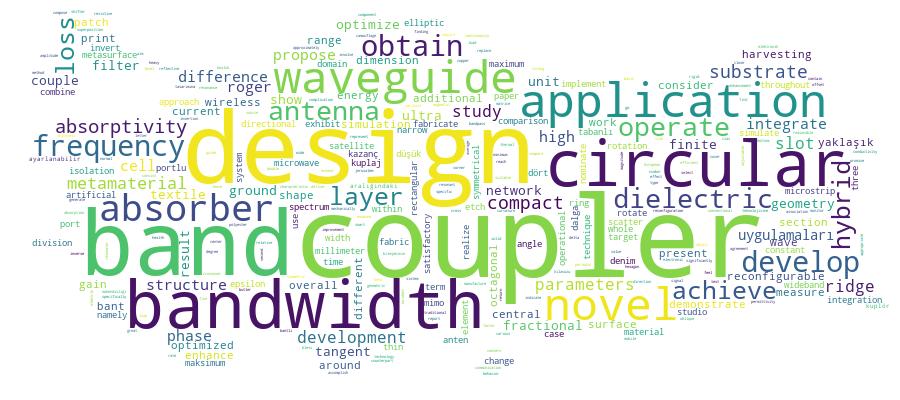
11 results
Scholarly Output Search Results
Now showing 1 - 10 of 11
Master Thesis Development of Millimeter Wave System Components for 5g/6g Wireless Networks(İzmir Ekonomi Üniversitesi, 2022) Cengiz, Mehmet Faruk; Gadelmavla, DıaaBu tez, boşluk dalga kılavuzu teknolojisine dayalı 5G ve mm dalga uygulamaları için üç sistem bileşeninin tasarımına ayrılmıştır. Üç bantlı bant geçiren filtre, sırasıyla 32,32 GHz, 35,75 GHz ve 38,12 GHz rezonans frekanslarına ve yaklaşık 0,6 dB, 1,1 dB ve 0,9 dB düşük ekleme kayıplarına sahip Ka-bant uygulamaları için tasarlanmıştır. V/W frekans bantlarındaki uygulamalar için dört portlu MIMO anten geliştirilmiştir. 72,7 ile 79,5 GHz aralığı arasındaki otomotiv radar ve uydular arası uygulamalarda kullanıma uygundur. D-bant uygulamaları için 140,9 ile 157,7 GHz aralığında yeni 4 x 1 dikdörtgen yarık anten dizisi geliştirilmiştir. Genel verimlilik %95 civarındadır ve maksimum kazanç yaklaşık 10 dBi'dir. DGS izolasyon geliştirme tabanlı dört portlu MIMO anteni, D-bandı uygulamaları için tasarlanmıştır. Empedans bant genişliği 148 GHz'den 161,7 GHz'e kadar uzanır. Farklı DGS geometrilerinin kullanılması kuplaj azaltmalarında etkili olup bu geometrilerinden elde edilen en yüksek kuplaj seviyesi -26,4 dB'dir, en düşük seviye yaklaşık -96 dB'ye ulaşır ve maksimum gerçekleşen kazanç 7,97 dBi'dir. 11,94 ile 16,91 GHz aralığındaki Ku-bant uygulamaları için özgün, ayarlanabilir metayüzey tabanlı kompakt UWB hibrit kuplör geliştirildi. Kuplör, 2,6 ile 4,8 dB arasında sürekli olarak ayarlanabilen büyüklük sunarken, faz farkları 77° ila 105° aralığındadır ve %34,45'lik kesirli bant genişliğine (FBW) sahiptir. Önerdiğimiz tasarım, Ku bandı/mm-bant aralığındaki ilk ayarlanabilir faz kuplörüdür.Article Citation - WoS: 6Citation - Scopus: 7A Novel Circular Reconfigurable Metasurface-Based Compact Uwb Hybrid Coupler for Ku-Band Applications(IEEE-Inst Electrical Electronics Engineers Inc, 2022) Abbas, Mohamed Atef; Cengiz, Mehmet Faruk; Allam, A. M. M. A.; Fawzy, Diaa E.; Elhennawy, Hadia M. M.; Sree, Mohamed Fathy AboA novel circular reconfigurable metasurface (MS) based compact ultra-wideband (UWB) hybrid coupler is developed for Ku-band applications. The coupler is developed using the substrate-integrated gap waveguide (SIGW) technology. The coupler structure consists of two layers, the bottom layer represents the artificial magnetic surface of the periodic structures and the ridges in between that guide the wave in the required direction with minimum dispersion. It involves the coupling section with a centered etched slot and two additional vias to achieve the basic hybrid coupler properties. This layer is nominated as the ridge layer. The second layer is a circular shape of a dielectric gap loaded with the top ground. The top ground is left solid for a non-reconfigurable coupler. Concerning the reconfigurable coupler, this layer contains an artificial metasurface of Jerusalem cross elements where the copper is etched around. This layer is nominated as the gap layer. This MS surface is mechanically rotated to offset the magnitude and phase of the signal going to the through and coupled ports. The findings obtained from the simulations show that the reconfiguration can be accomplished by rotating the MS around the source coupler's central axis. The rotation is tested between 0 & DEG; to 180 & DEG; in the counter-clockwise direction. The operating frequency range of the coupler is between 11.94 to 16.91 GHz, which covers approximately the whole Ku-band. The coupler delivers continuously adjustable amplitude between 2.6 and 4.8 dB while the phase differences within 77 & DEG; to 105 & DEG; over a fractional bandwidth (FBW) of 34.45%. It is manufactured using PCB technology and measured using network analyzer. A strong agreement is achieved between simulations and measurements. The proposed coupler can be used in traditional beam-forming and beam-steering networks by changing the rotation angle or the operating frequency. The developed coupler can replace the Butler and Bless matrices with their complication, heavy number of phase shifters, and crossover problems. The current work can be extended to operate in the mm-Wave band by changing the dimension and the material of the unit cell of the ridge layer of the coupler.Conference Object Citation - WoS: 1Citation - Scopus: 4Development of a Novel Ultra-Wideband Textile-Based Metamaterial Absorber for Mm-Wave Band Applications(IEEE, 2022-05-16) Akarsu, Gokberk; Cengiz, Mehmet Faruk; Fawzy, Diaa E.; Zengin, E. Buse; Allam, A. M. M. A.; Taher, Hany; Cleary, Frances; Nakmouche, Mohammed FaroukThis work proposes an ultra-wideband Metamaterial (MM) absorber for smart electronic textile (etextile) applications. The design is based on a novel cell geometry composed of two combined letter patches (A&S) printed on a grounded textile substrate. This unit cell geometry is specifically developed and optimized for millimeter-wave (mm-wave) applications. In this study, different types of textiles are considered, namely, Felt, Denim, and Polyester, and the achieved -10 dB reflective fractional bandwidths are about 50.36%, 44.49% and 41.42%, respectively. A comparison between conventional counterparts PCB-based dielectrics (FR-4 and Rogers RT-5880) and textile-based fabrics (Felt, Denim, and Polyester) indicates that the bandwidths exhibited by textile fabrics are significantly wider. This study also demonstrates that the bending of textile-based materials has an inverse effect on the -10 dB bandwidth, as the material's surface curvature increases. The current design is more compact, thin, and more efficient in terms of absorptivity in comparison to other reported absorbers and structures in the literature. The obtained results can be considered promising for the development of ultra-wideband e-textile-based applications such as energy harvesting, health monitoring, and camouflage systems.Conference Object Citation - Scopus: 1Design and Implementation Rgw Based Uwb Antenna Array for D-Band Applications(IEEE Computer Society, 2022-10-11) Cengiz M.F.; Allam A.M.M.A.; Fawzy D.E.; Ghanem M.G.; Helala M.A.; Fawzy, Diaa E.; Ghanem, M.G.; Allam, A.M.M.A.; Cengiz, Mehmet Faruk; Helala, Mahmoud.A.This study presents a new 4×1 rectangular slot antenna array based on ridge gap waveguide (RGW) technology for the use of D-band applications. The operating frequency of the proposed array antenna is 140.9-157.7 GHz. The Finite Integration Time-Domain (FITD) method is used to optimize the design parameters. Four rectangular slots are placed side by side and the RGW feeding network is used to feed them with minimal dispersion. Quarter-wavelength transformers are used to match the source to the load composed of the antenna array and feeding network. The antenna overall efficiency is around 95%. The antenna array's maximum gain is about 10 dBi, compared to the single antenna's gain of roughly 7 dBi. © 2022 IEEE.Conference Object Citation - Scopus: 2Design of Triple-Band Bandpass Filter Using Inverted Microstrip Ridge Gap Waveguide for Ka-Band Applications(IEEE, 2022-03-29) Cengiz, Mehmet Faruk; Nakmouche, Mohammed Farouk; Fawzy, Diaa E.; Allam, A. M. M. A.; Akarsu, Gokberk; Taher, HanyIn this paper, a triple-band inverted microstrip Ridge Gap Waveguide (RGW) filter is designed using a double octagonal ring resonator (RR) with corner cuts. The design parameters are optimized using the Finite Difference Time Domain (FDTD) method (CST studio simulator). The filter is implemented on Rogers RT5880 (epsilon(r) =2.2, thickness of 0.787 mm and loss tangent tan delta = 0.0009). It is selected because of its low losses at high frequencies. The proposed design operates within the Ka frequency band (27-40 GHz), with resonance frequencies of 32.32 GHz, 35.75 GHz, and 38.12 GHz. The return losses reach levels of about -35 dB, -25 dB, and -32 dB for the three bands, respectively. The filter exhibits a low insertion losses of about 0.6 dB, 1.1 dB, and 0.9 dB at the three resonant frequencies, respectively.Conference Object Citation - WoS: 2A Novel Substrate Integrated Gap Waveguide Ultra Wide-Band Circular Directional Coupler for Ku Band Applications(IEEE, 2023-03-26) Cengiz, Mehmet Faruk; Allam, A. M. M. A.; Fawzy, Diaa E.This study presents a new circular compact Ultra Wide-Band (UWB) substrate integrated gap waveguide (SIGW) based 3 dB hybrid coupler for Ku band applications. The coupling section is a circular structure with an elliptic slot and additional via to achieve equal-power division in two ports and isolation in the 4(th) port. To optimize the design parameters of the hybrid coupler, the Finite Integration Time-Domain (FITD) approach is employed. The operating frequency of the coupler is between 12.14 to 15.4 GHz with a central frequency of 13.5 GHz, a bandwidth of 3.26 GHz, and a Fractional Band Width (FBW) being 23.67%. A phase difference throughout the operational spectrum around 90 has been attained. The coupler is fabricated with an overall dimension of 33.8 x 33.8 mm(2). The measured and simulated scattering parameters demonstrate satisfactory agreement.Conference Object Citation - Scopus: 4Optimizing Ridge Gap Waveguide Based Slot Antenna Shape for Maximum Gain and Bandwidth for Satellite Applications(IEEE, 2022-05-17) Cengiz, Mehmet Faruk; Akarsu, Gokberk; Fawzy, Diaa E.; Allam, A. M. M. A.This work proposes different V-band antennas optimized to operate at 70 GHz with various geometric slots. The development is based on substrate integrated gap waveguide (SIGW) technology. Five geometries are considered, namely, rectangular, circular, hexagon, T-shape, and U-shape, with the target of maximizing the realized gain and bandwidth. The Finite Difference Time Domain (FDTD) technique is used to optimize the design parameters (CST studio simulator). The overall size of the developed antenna is 8.4x7.2x0.87 mm(3). The maximum obtained realized gain is found to be 10.98 dBi for the antenna with a rectangular slot. The circular slot antenna shows the highest S-11 < -10 dB bandwidth of 5.35 GHz in the range 66.53-71.88 GHz. The developed slot antennas are very appropriate for point-to-point wireless communication systems and inter-satellite and mobile satellite applications.Conference Paper Citation - Scopus: 3A Novel Substrate Integrated Gap Waveguide Ultra Wide-Band Circular Directional Coupler for Ku Band Applications(Institute of Electrical and Electronics Engineers Inc., 2023-03-26) Cengiz, Mehmet Faruk; Allam, A.M.M.A.; Fawzy, Diaa E.This study presents a new circular compact Ultra Wide-Band (UWB) substrate integrated gap waveguide (SIGW) based 3 dB hybrid coupler for Ku band applications. The coupling section is a circular structure with an elliptic slot and additional via to achieve equal-power division in two ports and isolation in the 4th port. To optimize the design parameters of the hybrid coupler, the Finite Integration Time-Domain (FITD) approach is employed. The operating frequency of the coupler is between 12.14 to 15.4 GHz with a central frequency of 13.5 GHz, a bandwidth of 3.26 GHz, and a Fractional Band Width (FBW) being 23.67%. A phase difference throughout the operational spectrum around 90° has been attained. The coupler is fabricated with an overall dimension of 33.8 x 33.8 mm2. The measured and simulated scattering parameters demonstrate satisfactory agreement. © 2023 European Association for Antennas and Propagation.Conference Object Citation - WoS: 8Citation - Scopus: 12A Novel 5g Wideband Metamaterial Based Absorber for Microwave Energy Harvesting Applications(IEEE, 2021-04-09) Akarsu, Gokberk; Nakmouche, Mohammed Farouk; Fawzy, Diaa E.; Allam, A. M. M. A.; Baskoy, Kadir; Cengiz, Mehmet FarukThis paper proposes a novel design of a compact and thin metamaterials (MMs) based wideband absorber aiming at specific microwave energy harvesting for 5G applications. The developed unit cell is obtained by combining two letters-like patches printed on a grounded dielectric substrate. The developed operating band is achieved based on the superposition of the two-resonances generated by the two letters. The simulations are based on Rogers RT5880 (thickness of 1.575 mm, dielectric constant of epsilon r=2.2, loss tangent of tan delta=0.009) and FR-4 substrates (thickness of 1.2 mm dielectric constant of epsilon r=4.3, loss tangent of tan delta=0.02). The obtained results show a wide 10 dB absorption bandwidth in the frequency range between 18 GHz and 30 GHz with absorptivity close to 99% for normal and oblique incident up top to 30 degrees in the case of Rogers RT5880. An absorptivity rate of 96% is obtained for the cased of FR-4 because of high dielectric losses. The obtained results are reasonable compared to other studies in the literatures.Conference Object Citation - Scopus: 3Development of a Symmetric Metamaterial Absorber With Bandwidth Improvements for 5g Millimeter-Wave Applications(Institute of Electrical and Electronics Engineers Inc., 2022-03-29) Akarsu, Gokberk; Buse Zengin E.; Nakmouche M.F.; Cengiz, Mehmet Faruk; Fawzy, Diaa E.; Allam A.M.M.A.; Taher H.; Taher, Hany; Buse Zengin, E.; Nakmouche, Mohammed Farouk; Allam, A.M.M.A.This study presents the development of a one-layer symmetrical Metamaterial Absorber (MMA) for millimeter-wave (mm-wave) applications. The target is to enhance the narrow band behavior and to achieve ultra-wideband with high absorptivity rates. The design is based on octagonal shaped cut rings and octagonal patches printed on grounded rigid substrate. A novel unit cell is developed and enhanced with the use of lumped elements technique to obtain ultra-wideband absorbers with high absorptivity rates. It is implemented on Rogers RT5880 with dielectric relative permittivity ? r=2.2, dielectric loss tangent of tan ?=0.0009, thermal conductivity of 0.2 W/m. K and with a 1.575 mm thickness. The characteristics of the MMA are examined in term of different resistive values, geometries, and angle of incidence. The obtained results show great enhancements in both the-10 dB bandwidth and in the absorptivity rates. The narrow bandwidth of the symmetrical design is enhanced by a factor of about 200 with average absorptivity of about 98% over the whole bandwidth. The current design is a very suitable for applications in the mm-wave. © 2022 IEEE.
