Turabi, Ali Sadi

Loading...
Profile Picture
Name Variants
Turabi, A. S.
Job Title
Email Address
ali.turabi@ieu.edu.tr
Main Affiliation
05.10. Mechanical Engineering
Status
Former Staff
Website
ORCID ID
Scopus Author ID
Turkish CoHE Profile ID
Google Scholar ID
WoS Researcher ID

Sustainable Development Goals

SDG data is not available
Documents

21

Citations

1485

h-index

14

Documents

20

Citations

1321

Scholarly Output

2

Articles

2

Views / Downloads

0/0

Supervised MSc Theses

0

Supervised PhD Theses

0

WoS Citation Count

117

Scopus Citation Count

127

WoS h-index

2

Scopus h-index

2

Patents

0

Projects

0

WoS Citations per Publication

58.50

Scopus Citations per Publication

63.50

Open Access Source

0

Supervised Theses

0

JournalCount
Acta Materıalıa1
Journal of Thermal Analysıs And Calorımetry1
Current Page: 1 / 1

Scopus Quartile Distribution

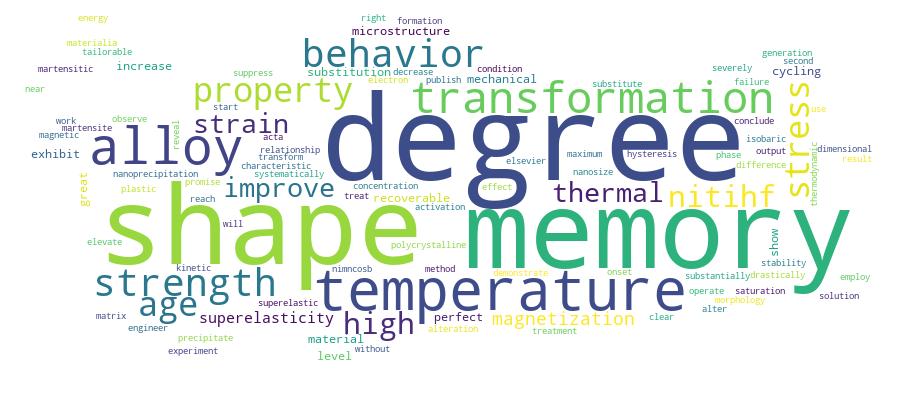
Competency Cloud

GCRIS Competency Cloud

Scholarly Output Search Results

Now showing 1 - 2 of 2
  • Article
    Citation - WoS: 110
    Citation - Scopus: 119
    High Strength Nitihf Shape Memory Alloys With Tailorable Properties
    (Pergamon-Elsevier Science Ltd, 2017) Saghaian, S. M.; Karaca, H. E.; Tobe, H.; Turabi, Ali Sadi; Saedi, S.; Saghaian, S. E.; Chumlyakov, Y. I.
    Microstructure of NiTiHf shape memory alloys can be engineered to have high strength and operate at high stress levels for a large temperature window. Nanoprecipitation is well-known method to improve the strength of materials but it can be employed to NiTiHf alloys to substantially alter their phase transformation characteristics (martensite morphology, transformation strain, hysteresis and stress). The martensitic transformation of Ni-rich Ni51.2Ti28.8Hf20 was severely suppressed in the solution treated condition (900 degrees C-3h/water quench) and after aging at low temperatures, while the transformation temperatures were greater than 100 degrees C after 650 degrees C-3h aging. Generation of nanosize precipitates (similar to 20 nm in size) after 3 h aging at 450 degrees C and 550 degrees C improved the strength of the material, resulting in a near perfect dimensional stability during isobaric thermal cycling at stress levels of greater than 1500 MPa, with work output of 20-30 J cm(-3). Superelastic behavior with 4% recoverable strain was demonstrated at low temperatures (-20 to 40 degrees C) after aging at 450 degrees C-3h and at elevated temperatures (120-160 degrees C) after aging at 550 degrees C-3h, with stresses reaching 2 GPa without the onset of plastic deformation. A clear relationship between thermal treatments, microstructure, mechanical and shape memory properties will be shown. (C) 2017 Acta Materialia Inc. Published by Elsevier Ltd. All rights reserved.
  • Article
    Citation - WoS: 7
    Citation - Scopus: 8
    Shape Memory Behavior of Ni(45)mn(40)co(5)sb(10-X)b(x)magnetic Shape Memory Alloys
    (Springer, 2021) Aydogdu, Yildirim; Turabi, Ali Sadi; Boddeti, Bhargava; Saghaian, Sayed Ehsan; Aydogdu, Ayse; Kilic, Gokhan; Abboosh, Omar
    The transformation temperatures, magnetization behavior, shape memory behavior, and mechanical properties of polycrystalline Ni45Mn40Co5Sb10-xBx(at.%) (x = 0, 1, 2, 3, 4, 5) alloys were systematically investigated. It was revealed that substituting Sb with B drastically increases the transformation temperatures, while it decreases the saturation magnetization due to the alteration of electron concentration of the matrix and formation of Co-rich second phases. With the substitution of Sb with 5% B, martensite start temperature and activation energy were increased from 50 to 316.8 degrees C, and 185 to 722.6 kJ mol(-1), respectively. The thermal cycling under stress, superelasticity, and failure experiments showed that shape memory properties and strength were improved by the substitution of Sb with B. The shape memory effect with maximum recoverable strain of 1.6% was observed with in Ni45Mn40Co5Sb9B1, and perfect superelasticity was exhibited at 220 degrees C in Ni45Mn40Co5Sb8B2. It was concluded that NiMnCoSb alloys can be used as high-temperature magnetic shape memory alloys as they exhibit transformation temperatures above 100 degrees C and show promising shape memory and superelasticity behavior, and there is a magnetization difference between their transforming phases.