
Way, Lyndon
Loading...

Profile URL
Name Variants
Way, Lyndon C. S.
Job Title
Email Address
lyndon.way@ieu.edu.tr
Main Affiliation
04.02. New Media and Communication
Status
Former Staff
Website
ORCID ID
Scopus Author ID
Turkish CoHE Profile ID
Google Scholar ID
WoS Researcher ID
Sustainable Development Goals
 1
1NO POVERTY
0
Research Products
 2
2ZERO HUNGER
0
Research Products
 3
3GOOD HEALTH AND WELL-BEING
1
Research Products
 4
4QUALITY EDUCATION
0
Research Products
 5
5GENDER EQUALITY
1
Research Products
 6
6CLEAN WATER AND SANITATION
0
Research Products
 7
7AFFORDABLE AND CLEAN ENERGY
0
Research Products
 8
8DECENT WORK AND ECONOMIC GROWTH
0
Research Products
 9
9INDUSTRY, INNOVATION AND INFRASTRUCTURE
1
Research Products
 10
10REDUCED INEQUALITIES
0
Research Products
 11
11SUSTAINABLE CITIES AND COMMUNITIES
0
Research Products
 12
12RESPONSIBLE CONSUMPTION AND PRODUCTION
0
Research Products
 13
13CLIMATE ACTION
0
Research Products
 14
14LIFE BELOW WATER
0
Research Products
 15
15LIFE ON LAND
0
Research Products
 16
16PEACE, JUSTICE AND STRONG INSTITUTIONS
1
Research Products
 17
17PARTNERSHIPS FOR THE GOALS
0
Research Products

Documents
30
Citations
324
h-index
11

Documents
29
Citations
187

Scholarly Output
20
Articles
12
Views / Downloads
54/25
Supervised MSc Theses
1
Supervised PhD Theses
0
WoS Citation Count
121
Scopus Citation Count
215
Patents
0
Projects
0
WoS Citations per Publication
6.05
Scopus Citations per Publication
10.75
Open Access Source
3
Supervised Theses
1
| Journal | Count |
|---|---|
| Socıal Semıotıcs | 4 |
| Music as Multimodal Discourse: Semiotics, Power and Protest | 4 |
| Dıscourse & Communıcatıon | 1 |
| Journalısm Practıce | 1 |
| Journal of Afrıcan Medıa Studıes | 1 |
Current Page: 1 / 3
Scopus Quartile Distribution
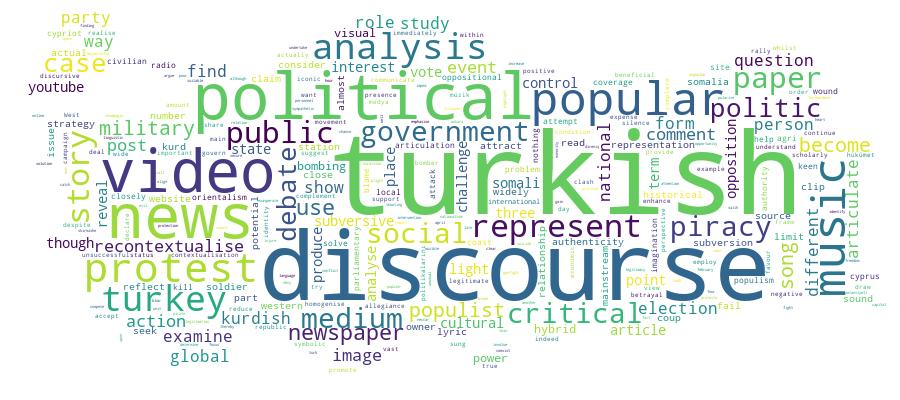
Competency Cloud
20 results
Scholarly Output Search Results
Now showing 1 - 10 of 20
Book Part Youtube as a Site of Debate Through Populist Politics: the Case of a Turkish Protest Pop Video [2016](Routledge, 2015-05-04) Way, Lyndon C. S.6During and immediately after the 2013 anti-government protests in Turkey, while there was almost complete state control over mainstream media, anti-government pop videos posted on YouTube became a symbolic rallying point for protest movements and attracted vast amounts of posted comments. These were widely shared and became sung in public places and during clashes with the police. These videos and the comments posted below them can be examined in the light of scholarly debates about the role of social media in public debate and protest movements. For critical discourse analysis, this provides the challenge to analyse the discourses realised in both the video and in the comments themselves. In popular music studies, it has been suggested that pop songs have been unsuccessful at communicating more than populist political sentiments. From a discursive point of view, the paper shows that this is indeed the case for one Turkish iconic protest video. It also finds that comments do not deal with the actual events represented in the video but seek to frame these in terms of wider forms of allegiances to, and betrayal of, a true Turkish people and in the light of homogenised and reduced forms of history.Article Citation - WoS: 18Citation - Scopus: 27Protest Music, Populism, Politics and Authenticity the Limits and Potential of Popular Music's Articulation of Subversive Politics(John Benjamins Publishing Co, 2016-10-07) Way, Lyndon C. S.Political discourses are found not only in speeches and newspapers, but also in cultural artefacts such as architecture, art and music. Turkey's June 2013 protests saw an explosion of music videos distributed on the internet. This paper uses these videos as a case study to examine the limits and potential of popular music's articulation of popular and populist politics. Though both terms encompass what is widely favoured, populism includes discourses which construct the people pitted against an elite. Past research has shown how popular music can articulate subversive politics, though these do not detail what that subversion means and how it is articulated. This paper uses specific examples to demonstrate how musical sounds, lyrics and images articulate populist and popular politics. From a corpus of over 100 videos, a typical example is analysed employing social semiotics. It is found that popular music has the potential to contribute to the public sphere, though its limits are also exposed.Book Part Citation - WoS: 21Citation - Scopus: 37Understanding Music as Multimodal Discourse(Bloomsbury Publishing Plc., 2017) Way, L.C.S.; McKerrell, S.Article Citation - WoS: 2Citation - Scopus: 3Visuals in Turkish Pop: the Subversive Role of Cultural Hybrids(Sage Publications Inc, 2016-03-24) Way, Lyndon C. S.Globalisation brings with it fears of cultural imperialism and a global mass culture from the West. This article contends that global imagery in the promotion of Turkish popular music actually enhances difference within Turkey. Global images are employed alongside Turkish ones to create an array of cross-cultural hybrids which Turkish viewers may read as expressions of cultural, political and social difference. A social semiotic approach is used on a sample of visuals from three genres of popular music. Analysis is complemented with an historical and social contextualisation in order to enhance understanding of how images blend the global with the local' in different ways to enable a medium of protest. Here is a case where global images are an integral part of hybrids which express dissent to national social and political issues.Article Citation - WoS: 5Citation - Scopus: 8Turkish Newspapers' Role in Winning Votes and Exasperating Turkish-Kurdish Relations: the Agri Shootings(Sage Publications Inc, 2015-11-30) Way, Lyndon C. S.; Kaya, Ece NurRelations between Turkish authorities and their Kurdish minority have been a source of conflict for decades. On 11 April 2015, in the run-up to Turkey's parliamentary elections, a gunfight broke out in the south-eastern province of Agri, resulting in six Kurdish people being killed and four Turkish military personnel wounded. Although skirmishes like this are not unusual, this caught the public imagination as it became clear that Kurdish civilians had helped wounded Turkish soldiers after the shoot-out. The government denied such help and was keen to place the blame for the fight on the Kurdish opposition in its attempt to dissuade the public from voting for Kurdish-oriented parties, thereby increasing their chances of securing a parliamentary majority. The Kurds were keen to do the same to the government for the sake of votes, while the mainstream opposition saw this as an opportunity to represent the government and Kurds as poor voting options. The Turkish media, polarised and closely aligned to political interests, recontextualised events in ways which showed their political ties. This article uses critical discourse analysis to show how this was done in three national newspapers. Furthermore, the article argues that representations as such do nothing to aid in solving the decades-old problem of how Turks and Kurds can coexist peacefully.Article Citation - WoS: 5Citation - Scopus: 4Orientalism in Online News: Bbc Stories of Somali Piracy(Intellect Ltd, 2013-03-01) Way, Lyndon C. S.This article considers how news stories about piracy off the coast of Somalia reflect E. Said's concept of Orientalism, that is, the West representing the Rest in ways beneficial to the West. Critical discourse analysis is applied to news stories from the international BBC news website to reveal strategies used to represent a non-western 'other' in need of control by a successful West. This legitimates the West's military presence and actions whilst challenging BBC's claims of objectivity. An historical account of both Somalia and piracy precede this analysis. The former illustrates how Somalia's current 'failed state' status is in part due to foreign involvement while the latter describes how this status has produced conditions conducive to piracy. Actions by the West together with the BBC's Orientalist perspective do little to relieve Somalia's hardship, suffering and ending Somalia's multiple problems.Book Part Citation - WoS: 4Citation - Scopus: 9Authenticity and Subversion: Articulations in Protest Music Videos’ Struggle With Countercultural Politics and Authenticity(Bloomsbury Publishing Plc., 2017) Way, L.C.S.Book Citation - Scopus: 36Music as Multimodal Discourse: Semiotics, Power and Protest(Bloomsbury Publishing Plc., 2017) Way, L.C.S.; McKerrell, S.We communicate multimodally. Everyday communication involves not only words, but gestures, images, videos, sounds and of course, music. Music has traditionally been viewed as a separate object that we can isolate, discuss, perform and listen to. However, much of music’s power lies in its use as multimodal communication. It is not just lyrics which lend songs their meaning, but images and musical sounds as well. The music industry, governments and artists have always relied on posters, films and album covers to enhance music’s semiotic meaning. Music as Multimodal Discourse: Semiotics, Power and Protest considers musical sound as multimodal communication, examining the interacting meaning potential of sonic aspects such as rhythm, instrumentation, pitch, tonality, melody and their interrelationships with text, image and other modes, drawing upon, and extending the conceptual territory of social semiotics. In so doing, this book brings together research from scholars to explore questions around how we communicate through musical discourse, and in the discourses of music. Methods in this collection are drawn from Critical Discourse Analysis, Social Semiotics and Music Studies to expose both the function and semiotic potential of the various modes used in songs and other musical texts. These analyses reveal how each mode works in various contexts from around the world often articulating counter-hegemonic and subversive discourses of identity and belonging. © Lyndon C. S. Way, Simon McKerrell and Contributors, 2017.Article Citation - WoS: 24Citation - Scopus: 35Youtube as a Site of Debate Through Populist Politics: the Case of a Turkish Protest Pop Video [2015](Routledge Journals, Taylor & Francis Ltd, 2015-05-04) Way, Lyndon C. S.During and immediately after the 2013 anti-government protests in Turkey, while there was almost complete state control over mainstream media, anti-government pop videos posted on YouTube became a symbolic rallying point for protest movements and attracted vast amounts of posted comments. These were widely shared and became sung in public places and during clashes with the police. These videos and the comments posted below them can be examined in the light of scholarly debates about the role of social media in public debate and protest movements. For critical discourse analysis, this provides the challenge to analyse the discourses realised in both the video and in the comments themselves. In popular music studies, it has been suggested that pop songs have been unsuccessful at communicating more than populist political sentiments. From a discursive point of view, the paper shows that this is indeed the case for one Turkish iconic protest video. It also finds that comments do not deal with the actual events represented in the video but seek to frame these in terms of wider forms of allegiances to, and betrayal of, a true Turkish people and in the light of homogenised and reduced forms of history.Article Citation - WoS: 3Discourses on Somali Piracy Intervention and Legitimacy(Routledge Journals, Taylor & Francis Ltd, 2013-03-12) Way, Lyndon C. S.Piracy off Somalia's coast has gained the imagination of the public and the attention of the media. Using critical discourse analysis, this paper considers stories about Somali piracy on the international BBC news website. A twin analysis is undertaken to determine how those involved in piracy and their actions are represented as well as how macro-discursive strategies of legitimation are employed. An historical contextualisation of Somalia and piracy complements the analysis. These analyses reveal how news stories do not focus on Somalis but on negative representations of pirates and positive representations of Western military powers. A number of linguistic strategies are identified that emphasise Western powers and articulate discourses that legitimate the continuing presence and actions of Western militaries. These discourses are drawn upon at the expense of discourses sympathetic to the plight of Somalis. These findings not only call into question the BBC's claims to objectivity, but also highlight the fact that stories do not promote conditions suitable for an end to piracy.
